



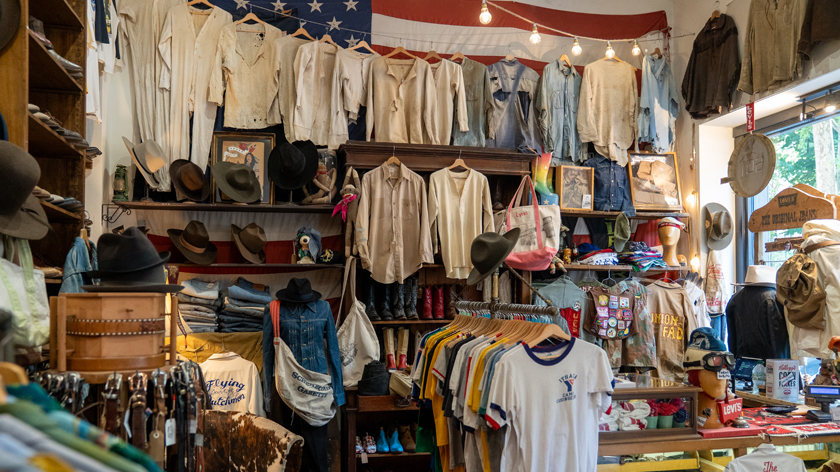
Two lights on Via Morgagni in Milan and a window that can’t go unnoticed.
Are you delving into the past or the future? To figure it out, you’ll need to step inside, take a look around, and, if you’re not familiar with the industry, ask a few questions. Which is exactly what we did: we asked Andrea Carulli, partner of Cristian Murianni and Davide Croatto, for some background on what Vintage is and why Union Fede is establishing itself as a benchmark in the international sector.
Union Fade: Why Milan is the home of the project
Hi guys, when did you open and why in Milan?
We opened in September 2021 and, well, we’re from Milan. Logistically, it was easy for us, but it would have been a mistake to do otherwise. Milan is the most international city in Italy, a hub for fashion, trends, and style. Milan was the ideal place.
From urban subcultures to a passion for vintage
You deal in very particular clothing and accessories. What is your background and how did you get to this point?
Cristian was the driving force behind Union Fade. He’s a photographer and has published magazines about snowboarding, skateboarding, outdoor, sneaker, and denim. His background is rooted in urban and sports subcultures, and his curious approach has led him to travel and interact. He worked in research for Denim Première Vision and WP Lavori in Corso, developing a passion for jeans, shirts, jackets, and more generally for garments with quality and a history. We are three partners, and vintage, with its implications for research, uniqueness, quality, and sustainability, is our passion.
Men’s vintage: workwear, military, and denim
For women, vintage clothing and accessories are mainly linked to used and dated high fashion products: Gucci, Chanel, Saint Laurent… For men, it is linked to workwear, military, western…
What is the Vintage of Union Fade?
Yes, the concept of Vintage is different for men and women, but it’s not just our interpretation; Vintage culture is founded on this. Most of the products you find here come from the very fields you mentioned, which have historically been male-dominated: the military, manual labor, animal husbandry, or certain types of sports.
We deal with products from the 1920s and 1930s, up to the 1970s, and throughout this time span you can see how the styles have changed. From the 1950s and 1960s, you’ll find shorter, boxier jackets, because trousers at that time had a higher waist. Most of the details of these products are functional: military jackets had slightly short sleeves, so as not to hinder the soldiers’ dexterity when operating weapons or machinery; aviator jackets were wide at the back and sleeves, to allow for maneuvering in the cockpit. The products were developed to meet a need for functionality and durability, which determines their richness and quality, a quality that has made these products last 50 or 100 years.
Who enters Union Fade today
Who is your customer: male, female, Italian, foreign?
Our typical customer is a man between 20 and 35, for the reasons mentioned above, although we also get women looking for pieces to mix and match with their looks. T-shirts from the 1970s, for example, are very small and fit perfectly on women’s bodies.
As for their origins, they’re mostly foreign. International tourism has exploded in Milan in recent years, including young people from Europe, America, Australia, and Japan. Young people whose culture is much more aligned with this style than ours.
The search for garments: how the Union Fade selection is born
Union Fade is the connection between your product and your customer. But how does the product get there?
The product doesn’t arrive, we go get it. Every item in the store is chosen and purchased individually.
We don’t do what 90% of second-hand stores do, which is to buy bales of clothing by weight. We don’t do it because, even if you buy at a low price, you end up with a very high waste rate, and because we’d still be very likely to end up selling worthless products. It’s a matter of choice; we select everything; we want to be aware of what we’re selling. We buy from markets and from suppliers with warehouses, mainly in the United States and Canada, Thailand, Cambodia, Vietnam, and Malaysia. Very little in Italy, and practically nothing from private individuals.
What criteria influence your choices?
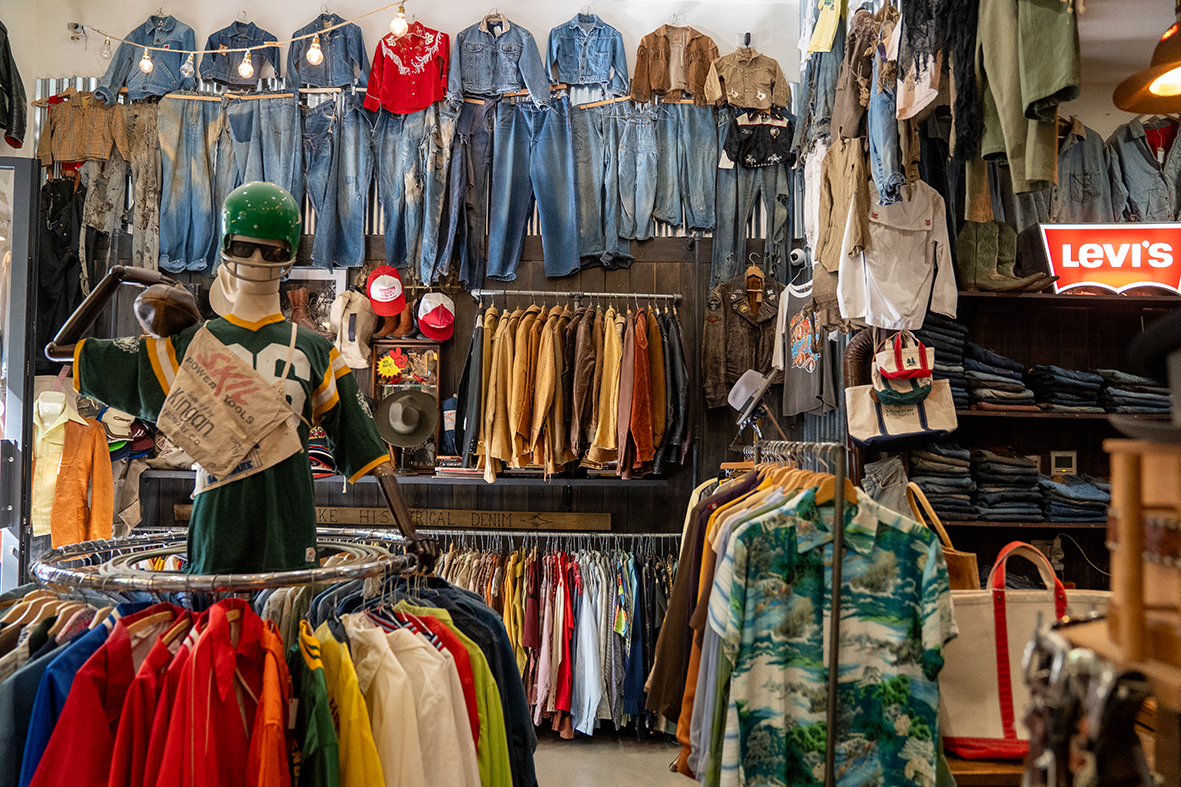
They’re influenced by needs, for example; we need to have a certain assortment of denim and leather jackets. Then there’s a world of visions, starting with Cristian, reaching Davide, and me, and varying depending on the moment, the historical period, a question of what’s in or could be in. Our customers are both young people who come in looking for jeans, and researchers from luxury brands who seek out archive pieces to inspire new pieces for their collections, as well as laundries, those companies that, through washing processes, create those ripped or worn effects on jeans.
When vintage inspires the big fashion brands
Do these researchers look, do they photograph?
We don’t allow photography, so they either buy or rent.
But at that point you no longer have the “big piece” you had, what do you do?
This is how it works: except for a few sporadic cases, we have to sell everything we own, otherwise it would become a museum, but it’s still a commercial activity.
You told me that brand researchers buy your garments to inspire them in creating pieces for new collections. Do you ever see those concepts actually being transferred to current products?
Yes, of course, it’s not just a matter of saying so, it happens that these people come back to us to show us, for example, that the detail of those new jeans is inspired by that old pair they bought.
In connection with what you just said, in the vintage field we hear talk of archives, what exactly are they?
Everything you see today is inspired by the past; all brands draw from archives, whether their own or others. References to the past are constant, which is why archives are so valuable.
Archives, authenticity, and value: what makes a vintage piece unique?
Someone who has no idea what you’re dealing with might say, “Wow, high prices for old, damaged products.” What justifies the price?
This was especially true when we first opened our business; we sometimes had to justify our prices. It happens less often now, but those who don’t understand the true nature of vintage need to be educated, to understand that we deal in rare, authentic products, the fruit of careful research, originating from a more or less distant past.
Compared to other countries that deal in this type of vintage, in the USA, France, England, we are the ones with the lowest prices, which take into account a market that is not yet mature and a lower purchasing power.
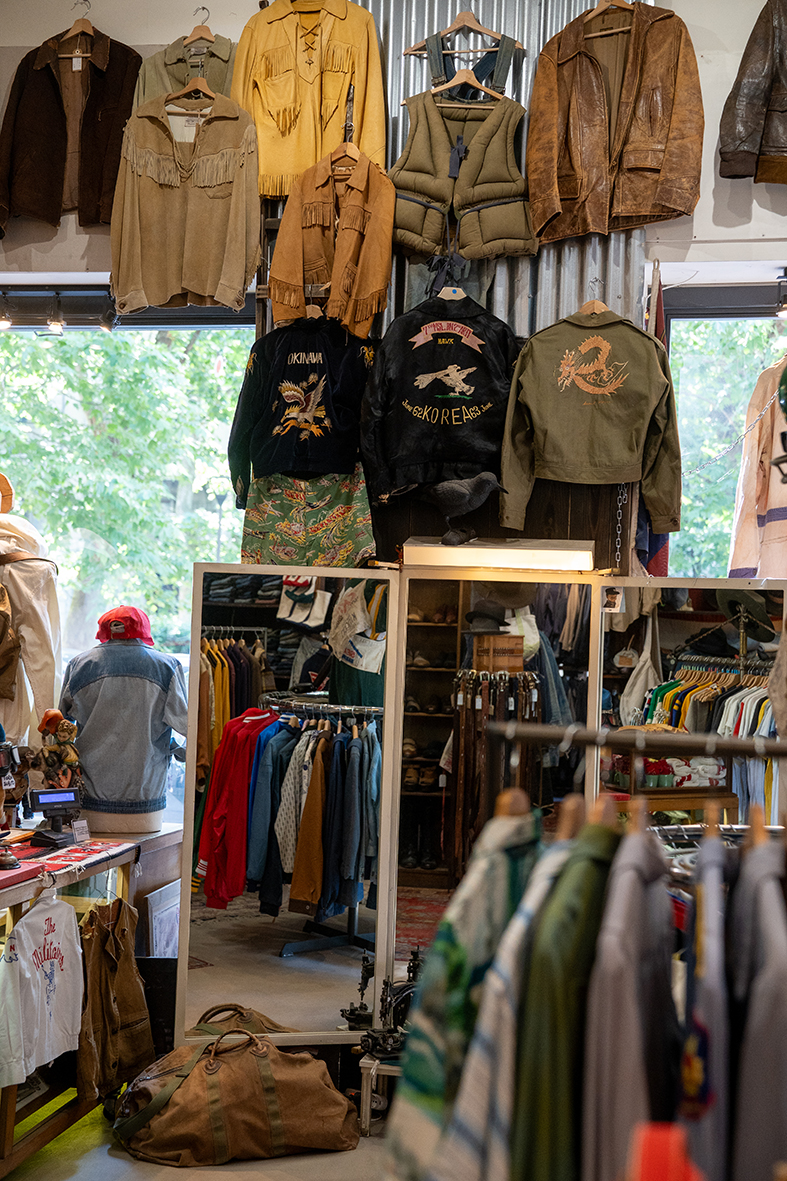
See those jackets hanging up there? Those are oriental jackets called Souvenir Jackets, made between the 1940s and 1960s. They’re handmade jackets with embroidered designs, each one different from the next. They were made by Western soldiers stationed at bases in the Indo-Pacific and then shipped as souvenirs to the US or Europe. A French boy spotted a jacket like this in one of our posts, wanting it at all costs because his father was stationed at that American base at the time. It was a €2,000 jacket.
The future of vintage lies in quality
Generally, will what is in stores now become Vintage?
I don’t think so, at least not the clothing you generally find in our stores. It’s a question of quality. On average, the quality of Western products is too low to last. It’s different with Japanese products, which have made, are making, and will continue to make quality products.
Quality. It’s what stands the test of time, it’s what will be Vintage tomorrow; everything else is disposable
.