



The life of a mountaineer is one of dedication and sacrifice. You don’t choose it for money or fame, it’s a calling.
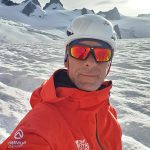
Stefano, partner of Silvia Loreggian (an accomplished mountaineer, editor’s note), has chosen to follow this path, becoming a mountain guide and professional mountaineer. For fifteen years, he’s put his heart and soul into it, and when something tries to stand between him and his dreams, he unleashes that reserve of grit that allows him to reach his goal.
4Outdoor is also on Whatsapp. Just click here to subscribe to the channel and stay up to date.
He made headlines with his first solo ascent of “Eternal Flame” on the Nameless Tower (6,251 m) – Trango Towers in Pakistan, and has just returned from Patagonia after making the first solo ascent of “Riders on the Storm”, established in 1991 by Kurt Albert, Bernd Arnold, Norbert Bätz, Peter Dittrich and Wolfgang Güllich and freed by Nico Favresse, Siebe Vanhee, Sean Villanueva O’Driscoll and Drew Smith in 2024. Here’s what he told us.
Stefano Ragazzo, the Interview
Let’s take a broad view, if I’m not mistaken, the one to Patagonia was the first trip with your partner Silvia.
What is the appeal of this place and why did you return this time?
Yes, Silvia and I have been to Patagonia twice, so this was my third trip. On those occasions we had been to Argentina, to El Chalten, but this time I went to Chile, to the Torres del Paine. Patagonia is a powerful, wild place, and I’m a climber who’s very fascinated by those very vertical, sharp mountains, which you find there rather than in the Karakoram, Alaska, or Mont Blanc. So, for the type of mountaineering I love, Patagonia is a very strong draw. After my experiences with Silvia, El Chalten had tired me a bit, because it’s now too overused, with shops, bars, nightclubs, and tons of people. I was looking for a place more similar to the Patagonia of the first climbers, wilder.
Then the idea of Chilean Patagonia began to buzz around in my head, which is quite isolated and still little visited by climbers.
Ok, so what was the project?
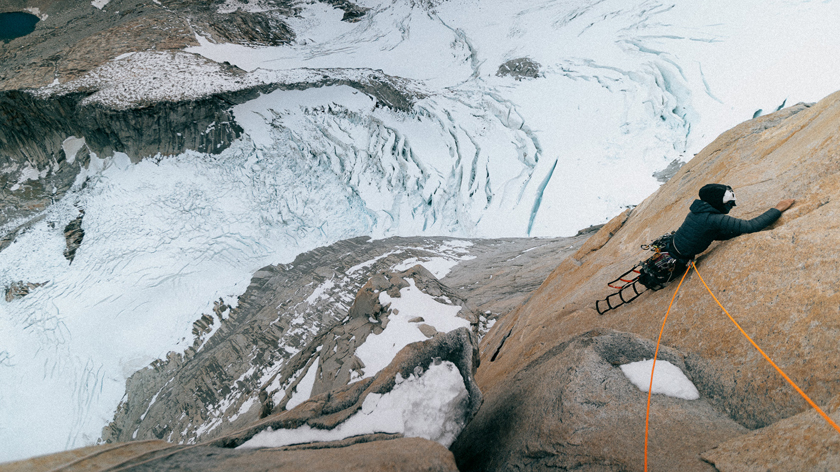
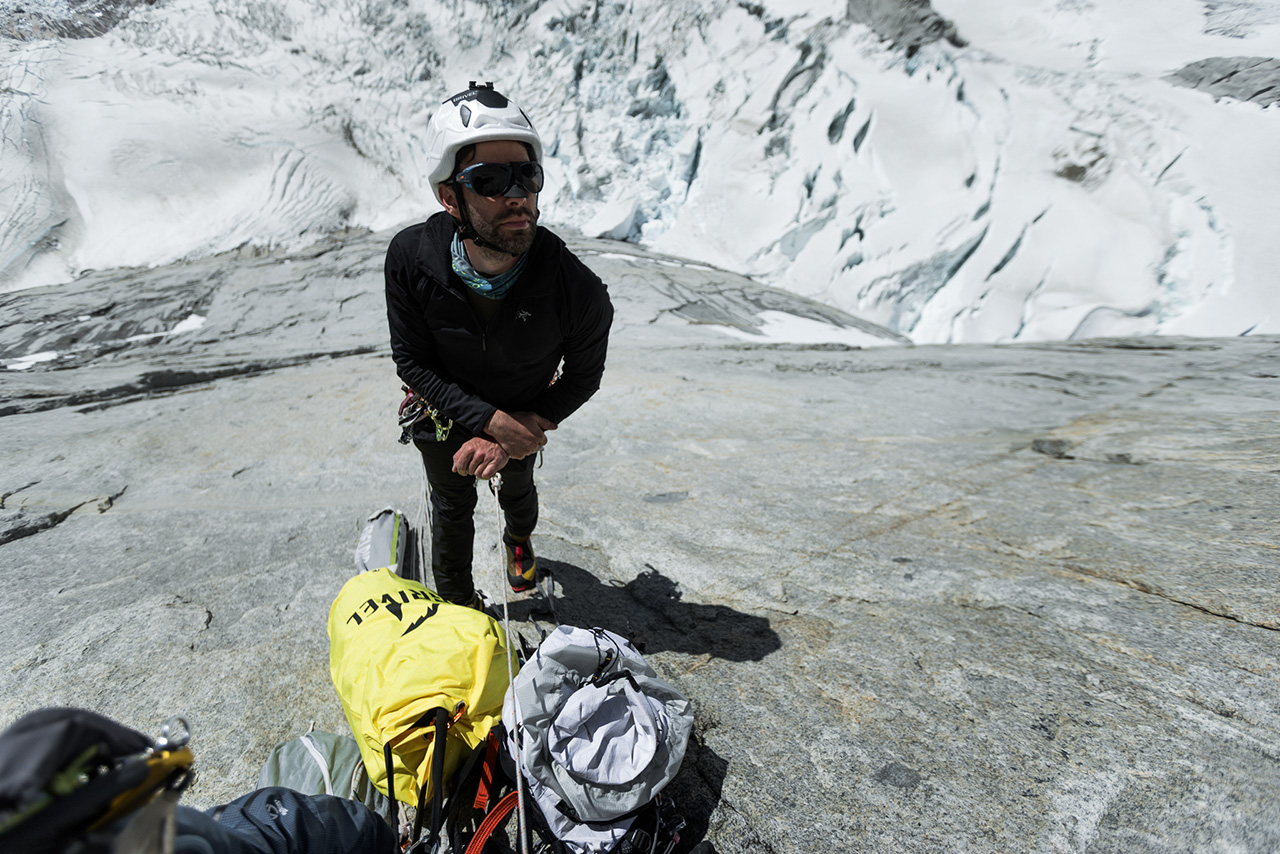
The plan was to climb “Riders on the Storm” on the Central Tower of Paine, a project so ambitious that I had no plan B. It was either that or nothing. I knew it wouldn’t be easy, not only because I intended to climb it solo, but also because of the complicated logistics of carrying all the necessary equipment.
I gave myself about a month and a half to do it.
How did you gather the information to prepare?
Well, it’s not easy to find information about Riders. There are a few reports online, but nothing comprehensive, and the climbers I asked weren’t very helpful. To put it bluntly: “none of them paid any attention to me.” Who knows why?
Then, by chance, a famous climber helped me… My coach is American and at the end of August last year he moved to Briançon, becoming neighbors with Nico Favresse. They climbed together at the crag, and while chatting, he mentioned that he was coaching a guy (me) who was planning on doing solo Riders.
Nico took an interest in the matter, was super kind, we got in touch and he gave me a lot of useful information.
What conditions did you hope for and what did you actually find?
I was hoping for some luck with the weather. I know Patagonia and I know it takes patience; the weather is very changeable, but in good years, you can find three- or four-day windows every week or week and a half. In reality, I wasn’t very lucky. The last good window was in November, and by mid-February I still hadn’t had a chance, which was also exceptional considering the location. In the first month and a half, I tried to climb whenever possible. At the time of the push, the weather wasn’t too bad, but the following week, a crazy low pressure system arrived, with the freezing level below 1,000 meters. It felt like winter in the Alps.
How did you prepare physically for this project? You mentioned having a trainer. Do climbers have trainers?
Yes, of course, if you want to do this professionally, you can’t leave anything to chance. I’ve had several coaches, and until last year I had Steve House, but lately I didn’t feel like I was getting the proper support. My expedition to Pakistan last year was ruined due to an injury to one of my two teammates, but I myself didn’t feel in good shape; I’d arrived there overtrained and felt like things weren’t working out.
When I came back I changed coach, I usually have a schedule to follow and every day I have a program to respect.
So training goes beyond climbing technique?
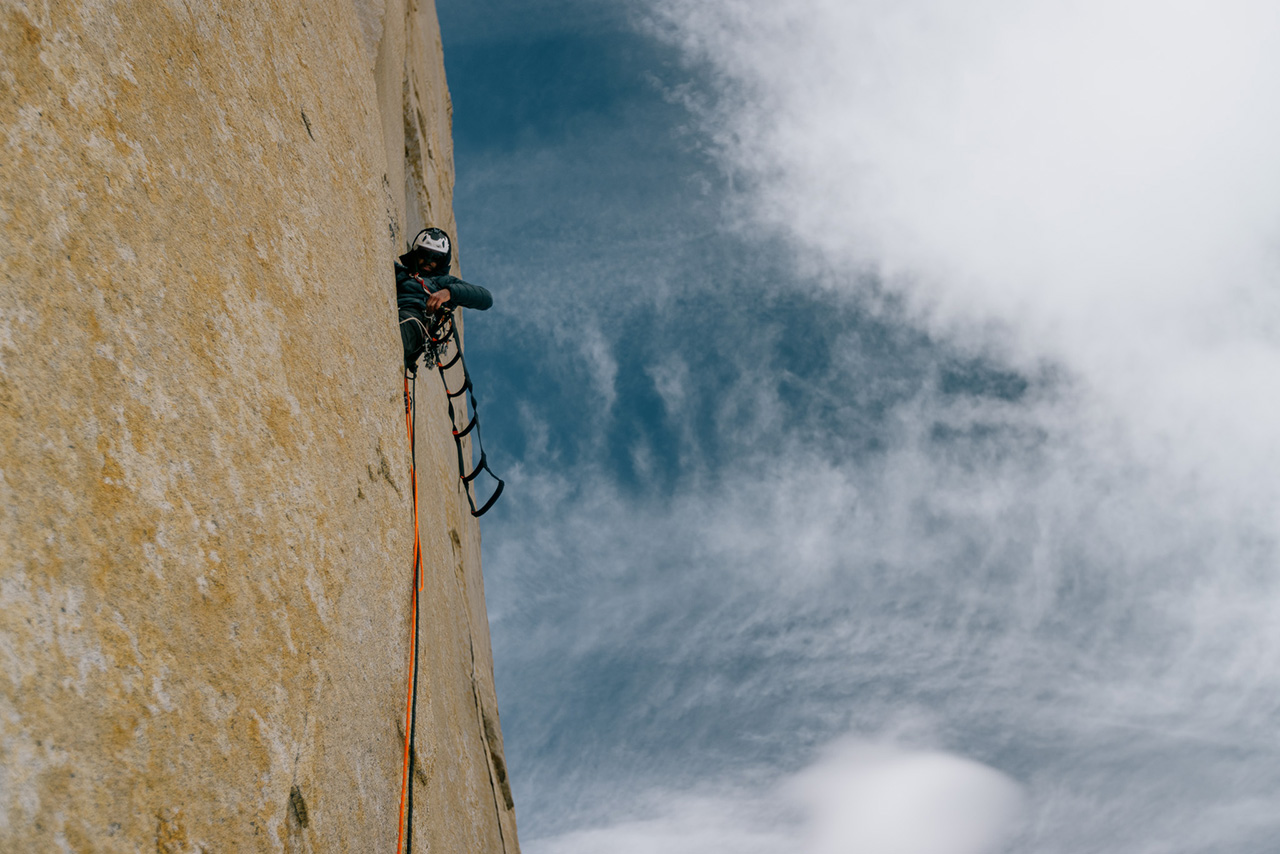
Yes, modern mountaineering, in addition to technique, requires the ability to move quickly and carry heavy loads. So I train my cardio with running, stair-machine exercises with a weighted backpack, and gym exercises, combined with ski mountaineering in winter, bouldering, etc., in addition to my work as a mountain guide.
Let’s go back to the expedition. You said you were there to climb solo. What style did you plan to adopt?
My idea was to tackle the climb in alpine style, meaning I intended to make a seamless push from the bottom to the summit, traveling as light as possible, even without a portaledge.
Then, once I got there, given the weather, I realized it was best to fix a few pitches and deviate into a capsule style. So, I fixed the pitches, hauled heavy bags, prepared food for two weeks on the wall, and stayed put until the end.
For those who have never seen the Central Tower of Paine and the route you climbed, what length are we talking about and how many pitches are there?
We are talking about a wall of about 1,200 m, almost 1,300, for 40 pitches.
So the plans changed along the way. What exactly happened?
Every day was a challenge. On the twelfth day on the wall, the last day of this low pressure, Rolo (Rolando Garibotti) and Silvia warned me of an approaching storm with winds of over 100 km/h. I was hanging in the portaledge on the twenty-fifth pitch when all hell broke loose.
A rock had pierced my shelter, and its location, under a large roof, meant it was being pushed upward by the wind. The structure of that portaledge features a metal rod at the base that keeps everything tensioned, and I had attached the guy ropes to that rod from below to stabilize it. The force of the wind, however, caused that rod to come loose, removing tension from the guy ropes. The sail effect, caused by the hole in the tarp, tore it and caused the portaledge to tip over.
I found myself upside down in my sleeping bag, with the gear falling into the void, my legs twisted around the guy ropes and the wind buffeting me everywhere.
I thought it was over, but after a minute of shock, I reacted. My climbing gear wasn’t anchored to the belay; I’d already carried it six or seven pitches higher, and I didn’t have much with me.
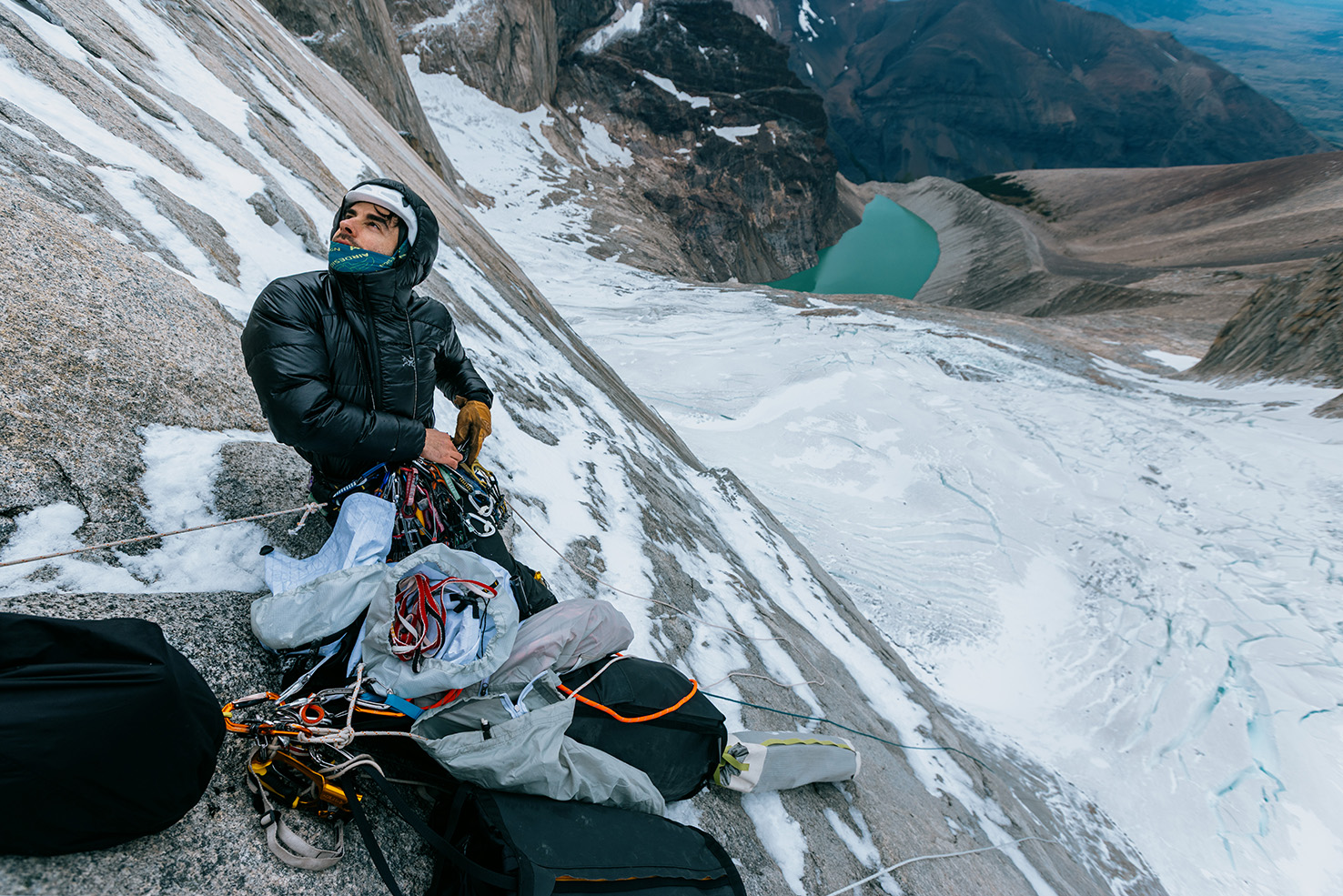
“On the twelfth day on the wall, the last day of this low pressure, I was warned by Rolo (Rolando Garibotti) and Silvia that a storm was approaching with winds of over 100 km/h. I was hanging in the portaledge on the twenty-fifth pitch when all hell broke loose.”
Couldn’t you have rappelled to the base of the wall with what you had?
No, I had a 60m rope, but rappelling in that wind would have been impossible.
At that point I removed the tarp from the portaledge and closed it, because it kept banging against me and risked injuring me.
I abseiled down the Grigri about 60 meters, carrying only the essentials: my stove, my sleeping bag, my wet boots, and some food. I remembered a small ledge below me.
It was around 8:30 pm when I arrived and the plan was to spend the night there, sitting with my legs in the void, my arms raised to cover the mouth of my sleeping bag to keep out too much snow and wind and to move my feet which were frozen.
It was a terrifying night, then as the morning dawned, the gusts became more sporadic and the sun came out. Before descending, I had to go back up to get some gear, so I waited a few hours before reaching the portaledge and having something to eat.
I was undecided whether or not to try to reach the summit. I was very tired, having been on the wall for 13 days. I slept a bit in the afternoon and the weather was improving, so I set my alarm for 3:30 a.m.
When I set off again I was very weak, I climbed the static lines with the jumars, forcing myself to keep a rhythm: action, rest, until I reached the material I had fixed a few days earlier.
From there, the route gets easier, with difficulties of 5°-6° and mixed terrain. The temperatures were good, I climbed in my fleece, hung all my bivy gear at the belay, and tackled the final pitches. Every hour, I tried to eat and drink something, I never stopped, and at 12:40, after about eight hours, I reached the summit.
I then rappelled down the same route, using the haul line because one of the ropes was damaged, to pitch 13, where I had established my first climbing camp. I reached the glacier at around 5:00 PM the following day.
“…the plan was to spend the night there, sitting with my legs hanging out in the air, my arms raised to cover the mouth of my sleeping bag to keep out too much snow and wind, and to move my feet, which were frozen.“
How did you manage logistics? You were alone!
Yes, I had underestimated this aspect a bit. Puerto Natales is the closest town to the Torres del Paine, about a 2.5-hour bus ride away, but there’s quite a trek to tackle from the park entrance. The first bivy spot is 6 or 7 hours away with a 1,400-meter elevation gain, beneath a large boulder. From there to the wall is another hour and a half. I was carrying 25 kg at most, and the first month and a half was spent going back and forth setting up the wall. Some guys from Puerto Natales helped me on the first go up to the boulder, then I managed on my own. Even on the way back.
After Eternal Flame, another solo expedition. Why this choice?
Climbing in a team or alone are two different things, and I appreciate both. I like the idea of seeing my level, technically, physically, and mentally. The choice to become a professional mountain guide and mountaineer was a huge challenge, which has completely absorbed my energy for the last fifteen years. So I like to see if I can push myself a little further, and it gives me satisfaction to realize that I can do things that others would never think possible. I seek pure, clean adventures, without interference, and solo climbs often come at the end of periods when things aren’t going as planned. In those moments, I try to channel negative energy into something positive, motivating myself with a challenging project that can redeem me psychologically. Eternal Flame or Riders are projects so big that, once I return, they give me the energy to face everyday life, which can sometimes be very difficult.
“Climbing in a team or alone are two different things, and I enjoy both. I like the idea of understanding my level, technically, physically, and mentally.”
One last, silly question. Couples usually say goodbye, anticipating one or more days of not seeing each other, and reminding each other to be careful. When you and Silvia say goodbye, in anticipation of an expedition, what do you say?
Well, sometimes we say that too, but we also say: “Give it your all.” We experience the process of creating a project side by side, from the beginning to the day we leave; we’re motivated and happy when it’s time to go. Of course, when she leaves, I feel a little more anxious, because I won’t be there and I won’t have full control, but I know her capabilities and her way of thinking, and that somehow reassures me.