

Finn and Jeffrey Spencer – Charting a Course for the Future
TEXT AND PHOTOS BY Axel Reese
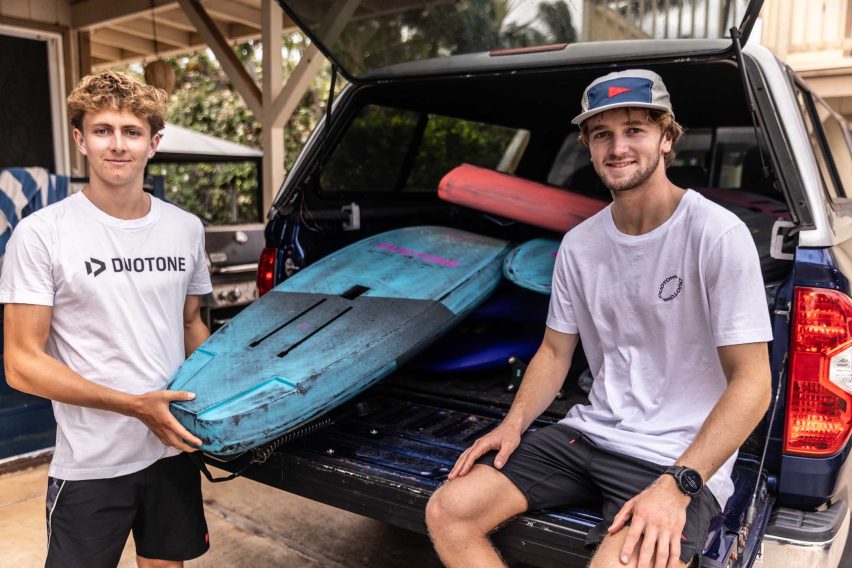
“Designed by Finn and Jeffrey Spencer”?! All Duotone boards in the 2025 range carry this exact phrase. Yet, it was Sky Solbach who designed the entire range of boards. At the Duotone Young Blood Camp in Germany, we met with Klaas Voget, Division Manager Duotone Wing and Foiling, and talked about this generational shift among Duotone shapers.
Somehow it has escaped many people’s attention that it is no longer Sky Solbach who is responsible for the new shapes, but Finn and Jeffrey Spencer, right?
Yes, Finn and Jeffrey Spencer are the designers responsible for the entire 2025 board range. They took over a lot of files and thus a good foundation from the previous shaper, Sky Solbach. Finn and Jeffrey aren’t left alone with us; we’re still involved in their development, but yes, a lot of the input comes from them! Even the new second-generation downwinder boards are entirely theirs.
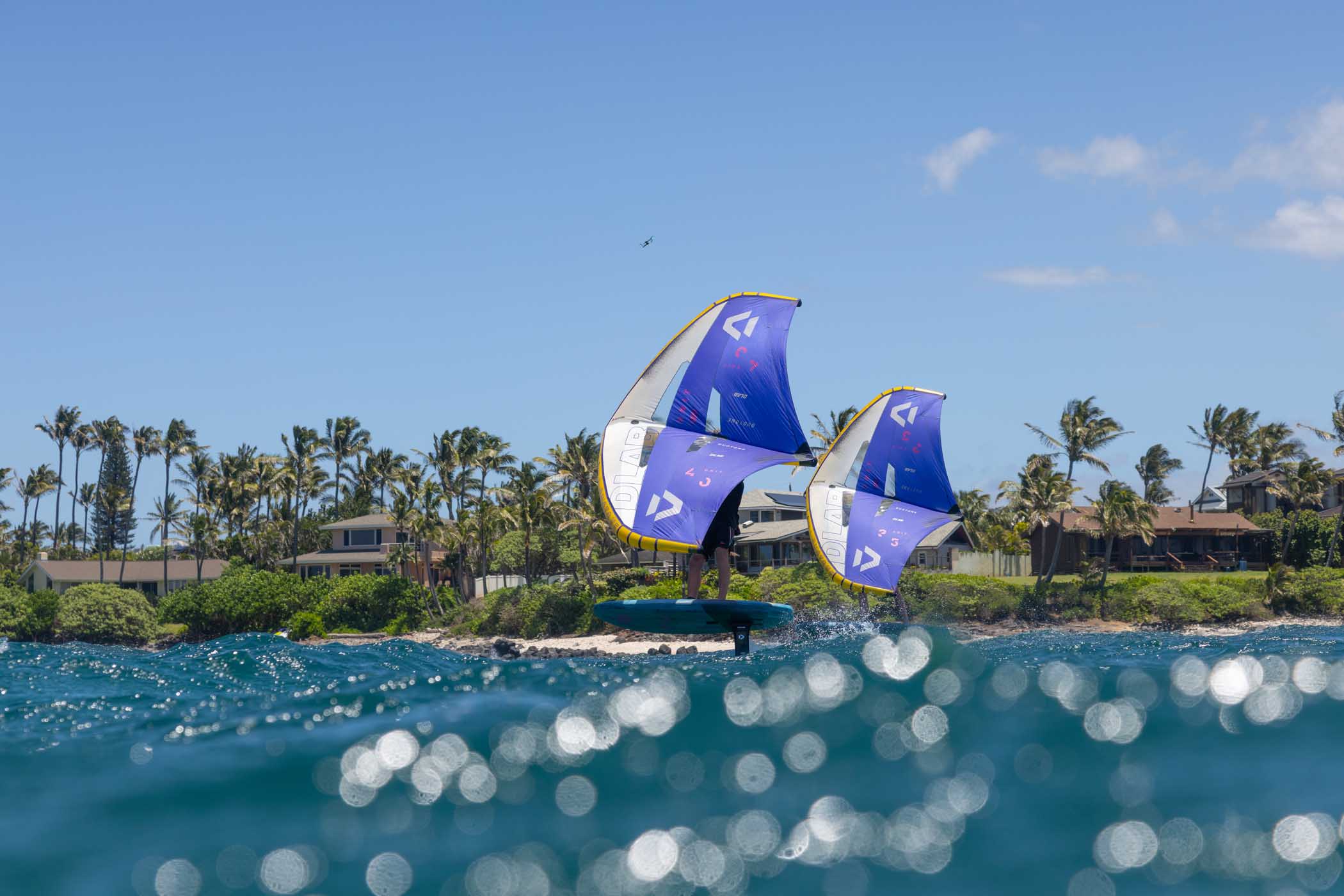
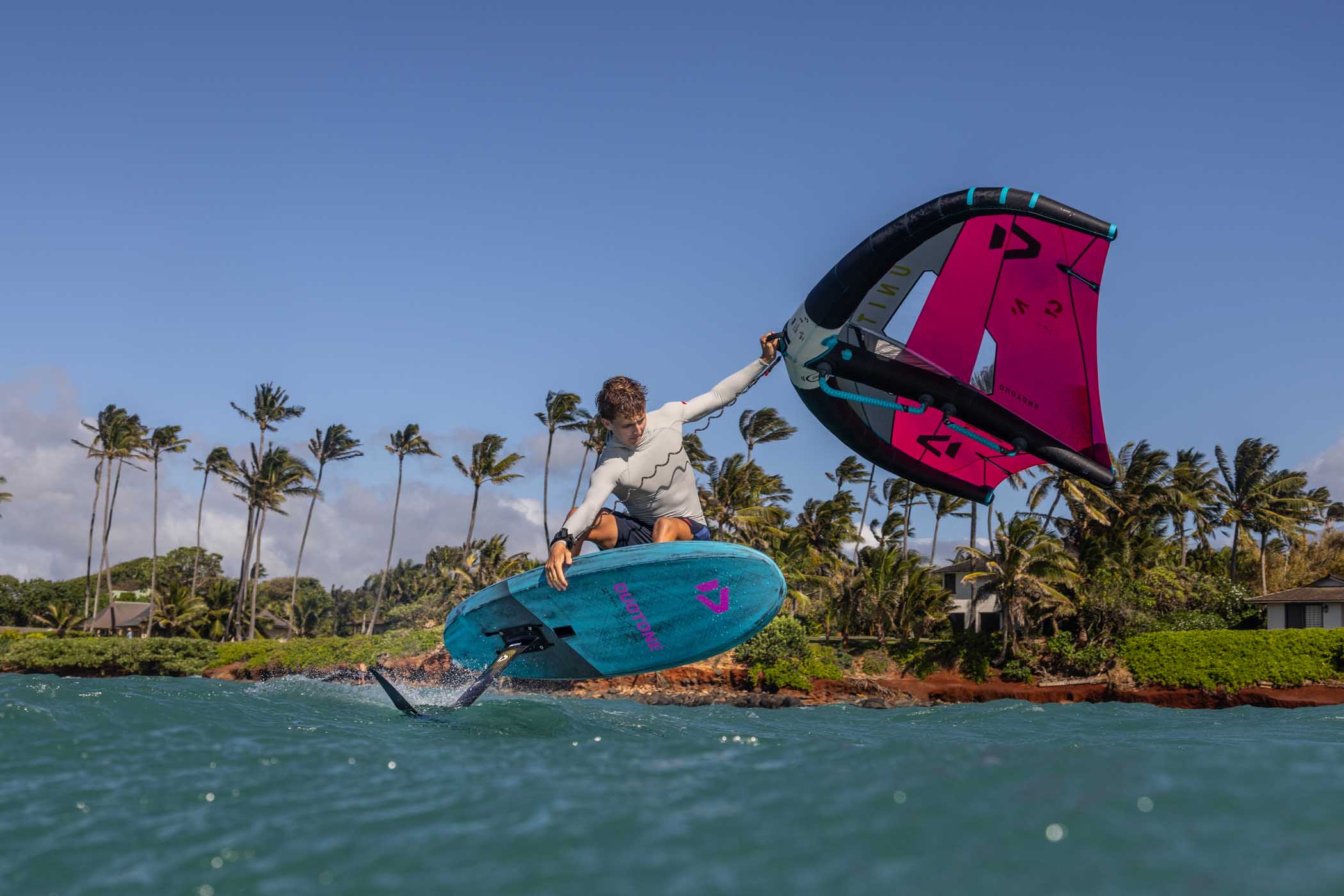
Since joining our team as riders, they’ve also been the main test partners of our wing designer Ken Winner. Finn and Jeffrey test prototypes on the waves and perform freestyle tricks, but they’re already developing a great feel for the subtleties of the wings even when riding straight. In the next phase, they were also integrated into the wing design team and are training with Ken as junior designers. Finn and Jeffrey are only 21 and 23, but they’re already very mature for their age. And they have a great understanding of what’s and isn’t suitable for the average wingfoiler, our end customer.
Define the direction for new product development in marketing and product management.
Yes, what are the strengths and weaknesses we see in our current range, and which products do we find particularly good among competitors? We discuss these together, and then Finn and Jeffrey create 3D files, which they then present to us, on which the board prototypes are built.
So Sky Solbach is no longer involved in the development and testing of wingfoil boards?
Our previous board designer Sky Solbach is no longer involved in kitesurfing and is fully involved in kitesurf design. Even when Sky delved into kitesurf design, we trained Finn and Jeffrey in all aspects of wingfoil board design and have now handed over the entire board area to them. If you have any technical questions, Sky is of course still available.
How long have Finn and Jeffrey been involved?
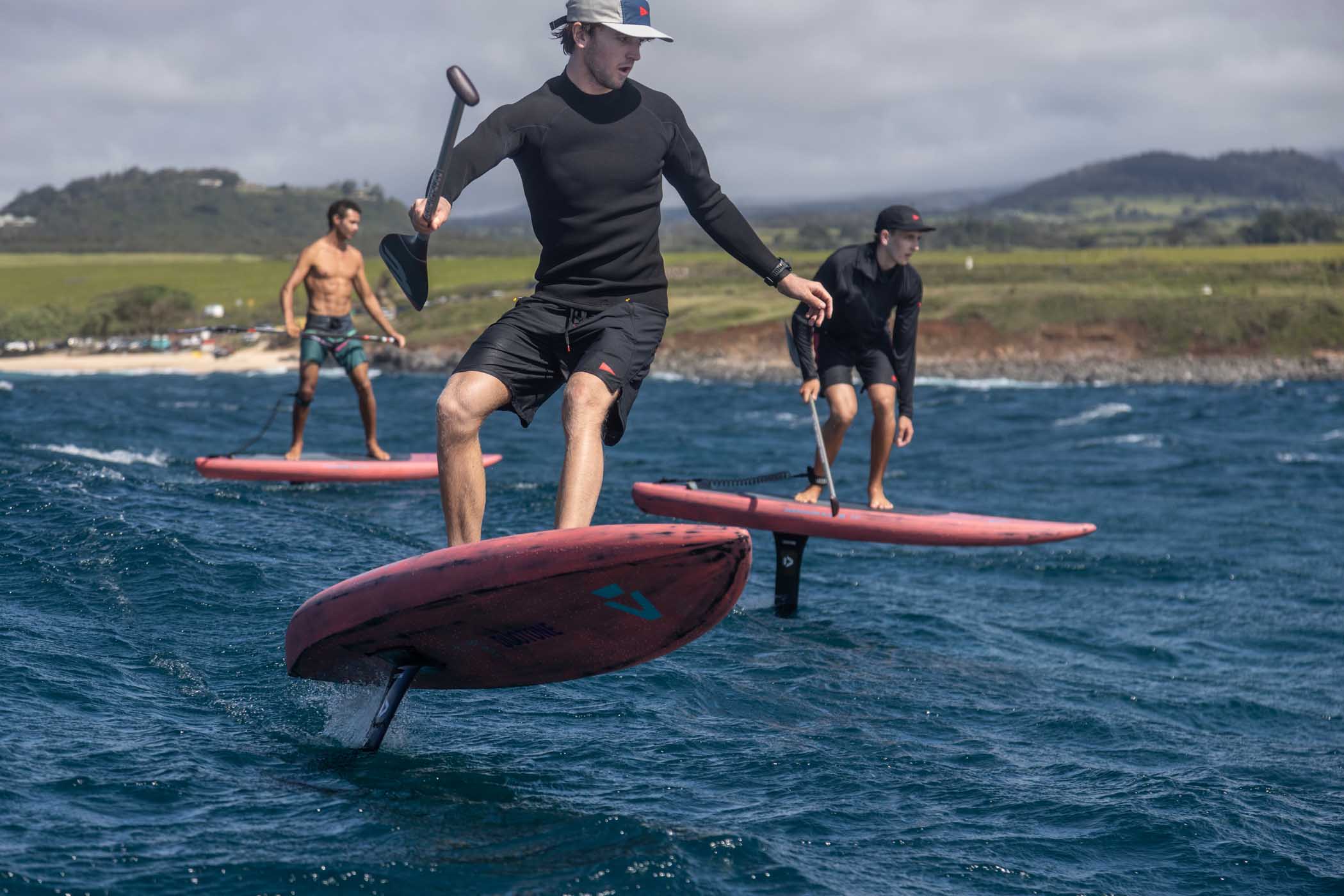
Since the fall of 2022, when the downwind topic became more prominent. At this point, the two were already providing more and more ideas and input to Sky, and both have essentially integrated Sky into the downwind board testing. Why? Finn and Jeffrey have been downwind surfers since the beginning, so they were involved in the topic right from the start. They have an extremely high level of riding and expertise, and have won numerous SUP Foil Downwind races. And, of course, they are fully responsible for the 2025 generation of our SUP Foil Downwind boards, which bear little resemblance to the original designs from three years ago.
“Full responsibility.” Working on projects as a separate team rider probably doesn’t work, right?
Finn has worked with 3D programs before, developed his own foils, and is very good at it. But wing design is a different kind of software, and the relationships between individual panels are very complex. Ken Winner has a lot of basic knowledge, gained over twenty years of kite design and subsequent years of wing foiling. Ken is now passing this expertise on to the two, who can learn a lot from him.
Especially if you know Ken Winner, you know he must have a lot of trust and belief in Finn and Jeffrey to be willing to pass on his experience, right?
Yes, but this was done proactively by Ken. He respects the two guys a lot, sees their potential, and also needs to “be able to work with them.” They provide excellent test reports, which I can read and confirm as well. From this point of view, it’s a good step forward that they are training with him. They’re not working independently on any sails yet, but they’re familiarizing themselves with the software and have currently received a small project that Ken is working on.
Ken is now almost 70 years old.
Yes, and at a certain point Finn and Jeffrey are catapulted into the heart of the adventure. It’s a very complex process, because you don’t have to design just one sail size, you have to go from 4 square meters to 3 square meters and 5 square meters, but maybe 3.5 is still not ideal, and, as always, there’s a deadline for producing the finished designs.
Okay, let’s focus on the testing. In addition to working on the designs, i.e. on the computer, Finn and Jeffrey also do a lot of testing on the water.
Yes, as I said, they are Ken’s constant testing partners. Ken has fun with the harness, uses a slightly more “racing” approach, tests the behavior of the sails on different courses, but Ken doesn’t jump or go to the wave spots. His tests involve guys like Peter Slate and Alan Cadiz, each with extensive experience in this field. Then the sail prototypes are delivered to the Spencers, who take them out on the waves or perform tricks in the air and test, for example, the hangtime of a sail or its handling in turns. The test results are also sent to our sail product manager and to me, to verify whether the direction is correct or not. Perhaps a sail prototype will also be sent to us in Europe, so we can test it in different conditions and verify its condition.
You’ve said it before, but only a few people in Europe realize it, because Finn and Jeffrey play such prominent roles in downwind foiling races. Both are deeply involved in the sport. At the SUP Downwind Triple Crown, the most prestigious foiling race in the world, which includes the Maui-Molokai and Molokai-Oahu races, Finn finished second and Jeffrey fifth out of nearly 200 participants. This SUP Triple Crown is attended by the “who’s who” of downwind foiling and is considered the Formula 1 of foiling. It’s the discipline where the foil makes the difference, because in downwind foiling, it’s the foil, the ability to read the waves, and the way the rider handles it that make the difference between victory and defeat.
The competition was focused on Finn and Jeffrey’s foils because they were so fast. The two weigh just 70 kg, not 90 kg or more, which usually gives the riders a huge advantage. Finn led for about 80-90% of the race, which no one expected. This means prestige and image for us, because Finn and Jeffrey did so well in these races. The foils they used there won’t go into production, but our new Hyper-Glides have the same designs, in a slightly larger version, as the ones Finn and Jeffrey had under their feet. And we’ve also learned a lot from this, which has then been incorporated into more commercial foils, like the Glide 2.0 or the new Carve 3.0.
How else do you see Finn and Jeffrey’s strengths?
They are very organized in their approach to testing and always have their best friend, their brother, with them, who has a very similar riding level. They understand each other perfectly, like brothers, they know what the other is talking about and, by the way, I understand what they’re talking about too (laughs) and we don’t miss anything. Their father is also obsessed with wing foils, but he has different needs and, for example, uses different volume classes. They live in Maui and are close to the trends.
How important is Maui as a destination for designers?
It’s a fantastic place for testing because Maui offers a lot of wind, summer trade winds with plenty of wind for downwind foiling, little wind, swells with good waves, flat water, and so on. All conditions can be found somewhere on the island. In the morning, you can test 7-square-meter kites in the harbor and 2-square-meter kites in the afternoon, then surf prone in corresponding waves on the South Shore. There are powerful waves in Hookipa and jump spots even in left winds.
And a lot of new things are created there because there are so many brands and the people behind the brands have been involved in water sports for so long. You can see a lot and we are close to the trends that are being created on Maui. This combines with “German engineering” on our part. The product management team and you also support the work on Maui, sometimes more closely, sometimes less.
We don’t leave them alone; For the past few years, I’ve been to Maui twice a year, where we test together and discuss next steps. This goes hand in hand with so many different conditions and “copying” us.
Added to this is our “preparatory work” with Duotone and the test lab, where constructions, seams, and so on are put to the test. We check the fabric materials, test them in the lab, generate results, and only then do we take them to the water for testing. Only then are prototypes built with these materials and constructions, without trial and error, and only tested in the water. This gives us the best possible quality assurance!
You’re putting a lot of effort into this, aren’t you?
This makes our Boards and More factory not the fastest, but the most comprehensive. And as a result, our customers receive a product that has been developed to the highest standards in terms of performance and quality and that has the best possible resale value. We’re still in the early stages of this sport, so the differences between products that have been developed to this level and those that haven’t are still relatively large.
And we are a brand in evolution. We don’t supply wingfoiling from the kitesurfing or windsurfing departments, but we have our own department. We don’t have a department that serves different shipyards, which not all brands can afford, and you can see that in the product.